Upper Arlington, Ohio

Root Collar Excavation

The most common slow killer in UA yards isn't a pest. It's a trunk set four inches too deep, with a root wrapped around it like a belt. I uncover the flare with compressed air — no blade near a root — and give the tree its footing back.

Text me a photo of the trunk →

Quoted per tree, after a free walk · Air spade, not a shovel · UA only

The wine-glass test

Go look at where your tree meets the ground.

A healthy trunk flares at the base like the foot of a wine glass — the buttress roots showing, widening out into the lawn. A trunk that goes into the ground like a telephone pole is a tree that was planted too deep, mulched too high, or both. The flare is down there somewhere, and bark that was built for air is sitting in the wet.

The wine glass

Trunk widens visibly at the soil line. You can see the tops of the big roots heading out. Mulch is a ring with a gap at the bark, not a pile against it. Leave it alone.

The telephone pole

Trunk goes straight in, same width at the soil as a foot up. Mulch or soil touches the bark. Sometimes a root visible at the surface running across the trunk instead of away from it. Text me a photo.

Why it kills slowly: bark at the collar isn't root tissue. Keep it buried and damp and it rots, and decay goes in at the one place the whole tree depends on. Meanwhile the roots that should be radiating outward hit the buried, compacted zone and turn — and a circling root gets thicker every year until it's strangling the trunk it belongs to. Girdling. The tree thins from the top, drops leaves in August, and gets blamed on drought, or a bug, or just getting old. It was the planting depth the whole time.
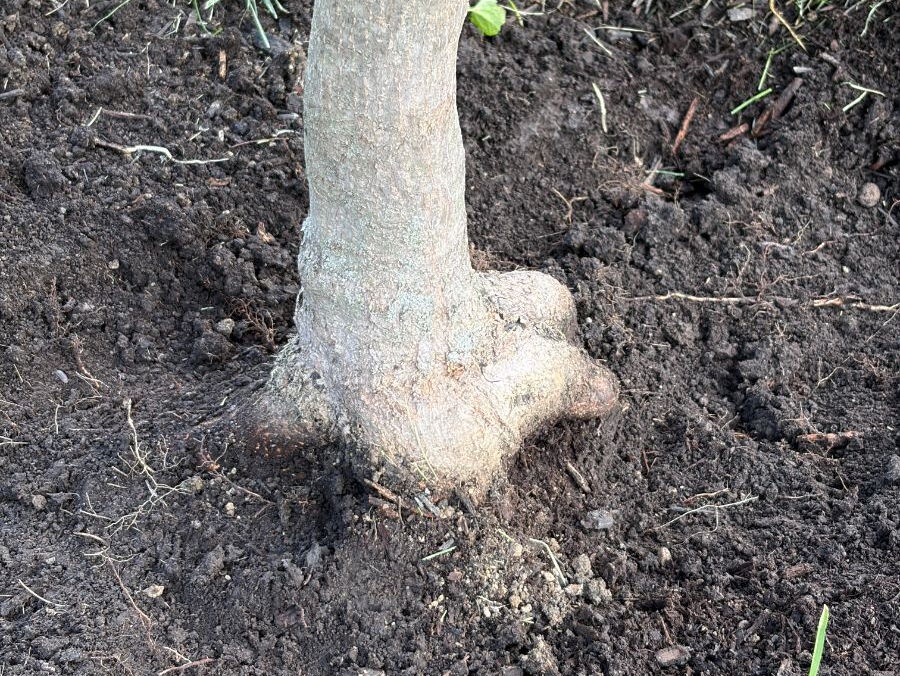
A freshly excavated root flare: a pale trunk widening into buttress roots, the soil taken back to the first structural roots
A root flare, uncovered. The foot of the wine glass, back in the air where it belongs.

More UA tree decline traces back to mowers, mulch, and planting depth than to anything an insect ever did.

The tool

Air doesn't cut. That's the whole point.

An air spade is a lance that fires compressed air into the soil. Soil breaks up and blows clear. Roots — even the fine ones — don't. A shovel at the collar of a mature tree is surgery with a club; the air spade lets me take the ground off a root system the way you'd brush soil off a fossil, and actually see what's there before I decide anything.

Same tool, same principle, for the whole root zone: radial trenching to break up seventy years of lawn compaction, vertical mulching, loosening the ground around a tree that's been driven over or built next to. Root management, not root removal.

What happens
01The walk — free. Every tree on the property, root flare to canopy. We decide together which collars need opening, and I tell you if none do
02Excavation by air — soil and mulch come off the collar and out to the first structural roots. Nothing with an edge touches the tree until I can see what I'm cutting
03What I find, photographed — the flare, the depth it was buried, every girdling root, before and after, in your tree's chart
04Corrections — girdling roots cut where they're strangling, the stem-girdling ones first; adventitious roots sorted; the true flare left at grade
05The regrade — mulch reset as a ring with a gap at the bark, never a volcano. The collar stays open to air from here on
06The root zone is open, so it's the moment to pull a soil sample if you want the lab read — that's the front door of the Soil & Nutrition Program, and you're standing in it
What it costs
Quoted per tree, after the walk.

A mulch volcano on a young tree is an hour. A mature oak with a girdling root the size of your wrist is most of a morning. The photo tells me which one I'm looking at before I arrive — so text it.

Text me the photo → Want it caught before it's a problem? See Tree Steward →
After the storm

The trees that tipped didn't fail at the top.

It's been the wettest August anyone here can remember, and the wind came with it. Trees that go over in a storm mostly don't snap — they tip, root plate and all. And a tree that tips very often turns out to have had a compromised collar: a girdling root, decay where the trunk was buried, a root system that never spread because it was set too deep to begin with. Saturated ground just finished what the planting started.

If your tree is standing and the neighbor's isn't, now is the time to look at the base of yours. And if someone has already quoted you to take a standing tree down because it looks like the one that fell — text me the quote before you sign it. Post-storm quotes run high. I'll tell you, free, whether it has to come down, whether it can be saved, and whether the number is fair.

Send me the quote first →
Fair questions

Asked and answered.

Can't I just pull the mulch back myself?

For a mulch volcano on a young tree, yes — rake it back until you see the flare, and leave the collar open. If you reach the flare and find a root running across the trunk, or you dig and dig and never find a flare at all, stop and text me a photo. That's the job.

Will the tree recover?

Depends how long it's been buried and how far the girdling got. A young tree caught early: yes, usually fully. A mature tree with years of decay at the collar: I tell you what the excavation shows and what it means, and it goes in the chart. Sometimes the honest answer is that it's time to plan this tree's replacement — and better to learn that from me with the root zone open than from a crew after the next storm.

Does the air spade hurt the tree?

Air doesn't cut. The tree loses nothing it needed and gains air at the one place it needed it. I avoid the worst of drought and leaf-out stress when I can; with the ground as wet as it is right now, the soil comes off easily and the roots are easy to read.

Is this part of the programs?

The walk that finds a buried collar is the first visit of both programs, and Tree Steward properties get it caught on the seasonal round before it's a problem. On its own, it's a one-time job — quoted per tree after the free walk.

How it starts

Look at the base of your tree today.

Text me a photo of where the trunk meets the ground. I'll tell you what I see — free — and whether it needs opening. If it does, the walk is free too, and the quote comes after it.

Text David: (614) 312-2979 →

Upper Arlington, Ohio · Quoted per tree, after the walk · The walk is free

Rather not text?

Leave your address — I'll set up the walk.

Same-day reply. No obligation, no pressure.

Text David Call