Native Trees · Upper Arlington, Ohio
Everyone sells “Ohio native.” The native trees of Upper Arlington are more specific than that — this ground’s own stretch of the Scioto Valley, documented in 1925. The forest kept records.
The witness forest, drawn from the record — oak and shagbark hickory overhead, beech beside them; redbud, serviceberry, and pawpaw in the shade. The same plate the front page starts from.
Printed in this season’s ink · impression no. 4242
Native planting is the moment — Ohio was the first state in the nation to write a Native Plant Month into law, and nurseries can hardly keep natives in stock. But read the tag closely: “native” usually means native to somewhere in Ohio, or somewhere east of the Mississippi. A state is a political boundary. A watershed is an ecological one. This page is native the way ecologists mean it — this valley, this soil, this ground — and it can be that specific because the record survives.
When the first land surveys came through this country, the surveyors anchored their corners to the biggest trees at hand — and recorded each one, species by species, in the field notes. They weren’t botanists. That’s exactly what makes them trustworthy: nobody was arguing a theory, they were just writing down which tree they blazed.
A century later, in 1925, the botanist Paul Sears went back through those records and reconstructed Ohio’s original vegetation, township by township. For the stretch of the lower Scioto that includes Upper Arlington, his pages read like a cast list. One line stands above the rest:
“‘Oak’ was mainly represented by hickory. This was unusual.”
— Paul Sears, 1925 · on the lower Scioto · p. 143
In plain English: this was oak country, and yet when the surveyors tallied their corner trees on our stretch, it was hickory that kept answering the roll. Nobody was calling an oak a hickory — the quotation marks are Sears’s own. “Oak” was his map’s shorthand for the whole white oak–black oak–hickory forest type, and on this ground the hickory was turned all the way up. That’s why a shagbark hickory anchors the canopy plate on the front page. And it’s why yards matter so much here: a street-tree list is written for the strip between sidewalk and curb, and a deep-rooted, two-century hickory was never a curb-strip tree. The signature tree of this ground comes back through yards — one at a time.
The record has a second witness. In 1966, Robert B. Gordon drew those same survey notes as a map — Natural Vegetation of Ohio at the Time of the Earliest Land Surveys, for the Ohio Biological Survey — and on it, Upper Arlington gets a portrait: the upland reads beech forest, with an oak–sugar maple ribbon tracing the Scioto along the city’s western edge. Sears heard the hickory answer the roll; Gordon drew the beech it grew among. Two botanists, forty years apart, reading the same field notes into the same forest — this town was beech, oak, and sugar maple before it was streets.
Four species are named exactly here — the lower Scioto — in Sears’s text. Beyond those four, the evidence fans out in rings: species he traced up the river valley, the forest he mapped around it — and beneath all of it, the shade layer the surveyors never wrote down.
The four the record puts right here.
HickoryCarya spp.
The headline — the quote above. The signature tree of this ground, and today it comes back one yard at a time. Slow, strong, and good for a couple of centuries.
Tulip poplarLiriodendron tulipifera
“Mixtures with poplar,” Sears wrote of the lower Scioto. Named in place, approved for the tree lawn, fast, straight, and tall — the easiest yes on this page.
Black walnutJuglans nigra
“Mixtures with poplar, cherry, walnut.” It thrives in our alkaline ground — the original tenant, still perfectly suited. A yard tree rather than a curb tree, and in the right yard, a legacy tree.
Black cherryPrunus serotina
Same sentence, same page. Brittle wood and messy fruit make it a woods-and-yards tree, not a street tree — and the forest doesn’t care. One of only four species named in place. Worth knowing before you cut one down.
A southern company of trees Sears traced “eastward and northward along the Upper Ohio and its great tributaries, the two Miamis and the Scioto.” Our river was their road north.
HackberryCeltis occidentalis
Thrives in alkaline soil and shrugs off nearly everything else. If you want a native shade tree with no drama, this is it.
Yellow buckeyeAesculus flava
Sears’s “sweet buckeye” — the bigger, cleaner cousin. Approved as a large street tree, and almost nobody plants one. An easy way to own something rare that belongs here.
Ohio buckeyeAesculus glabra
The state tree came up our river. It likes lime, it likes this ground — give it a yard and it’s happy.
American sycamorePlatanus occidentalis
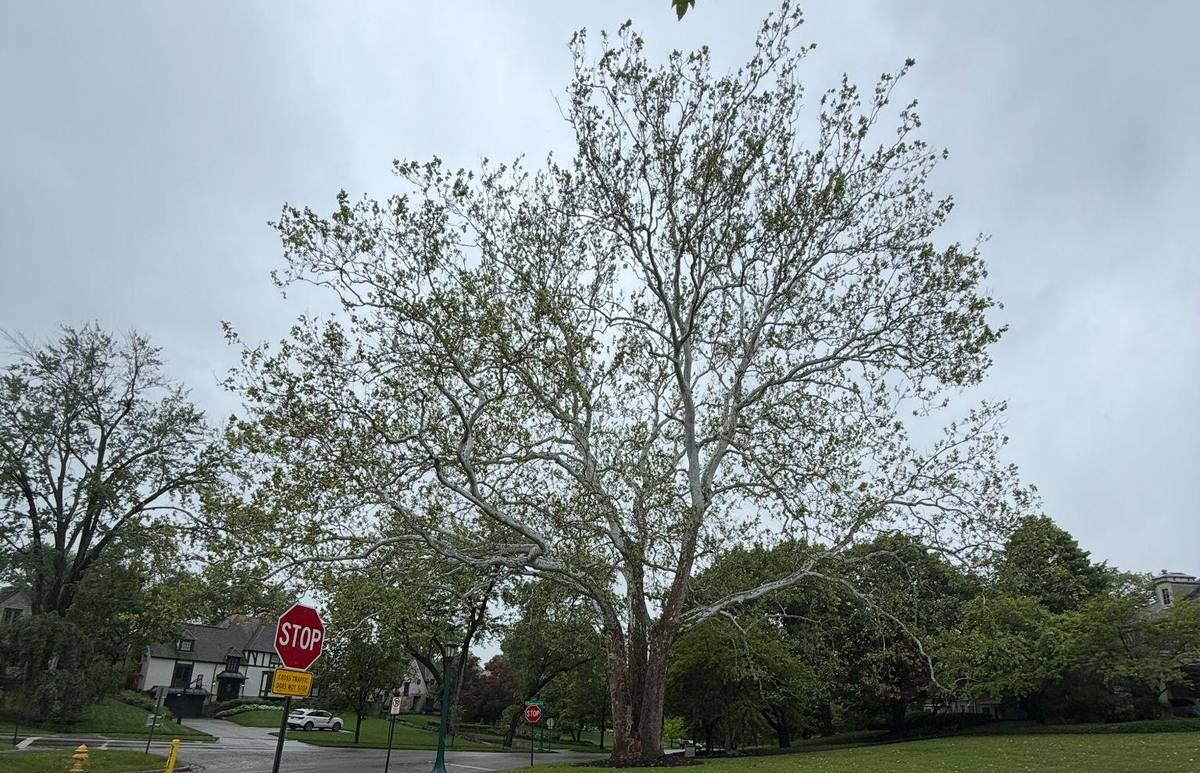
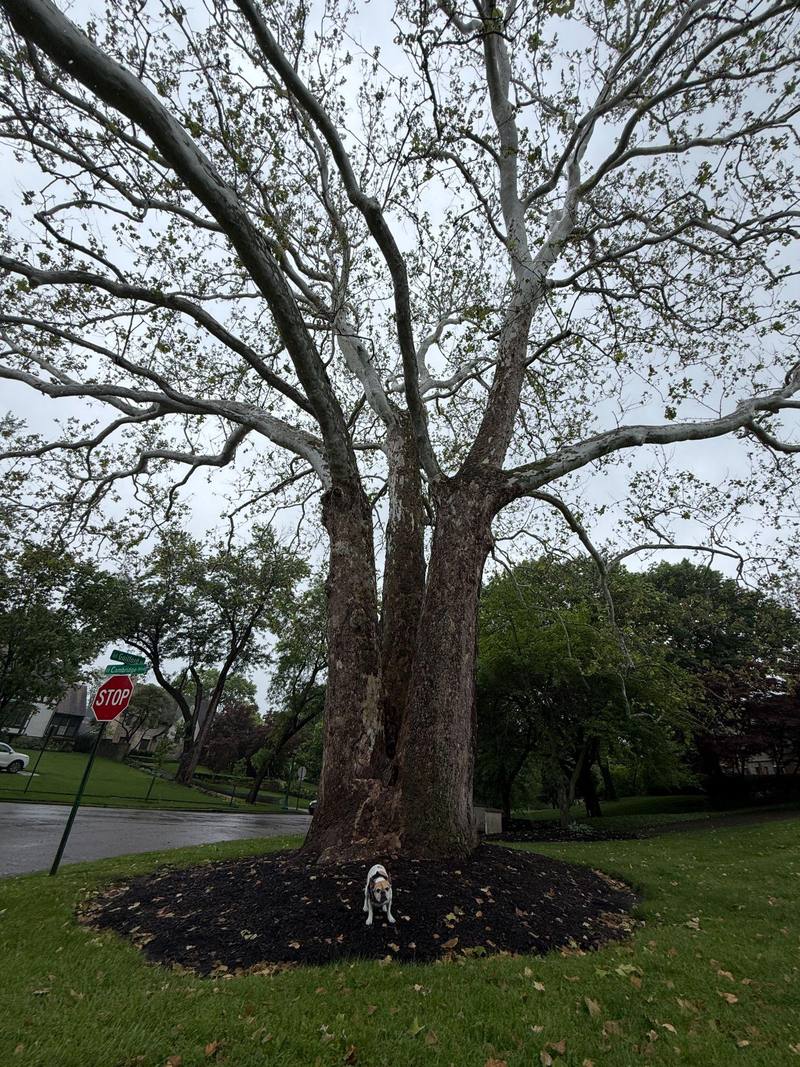
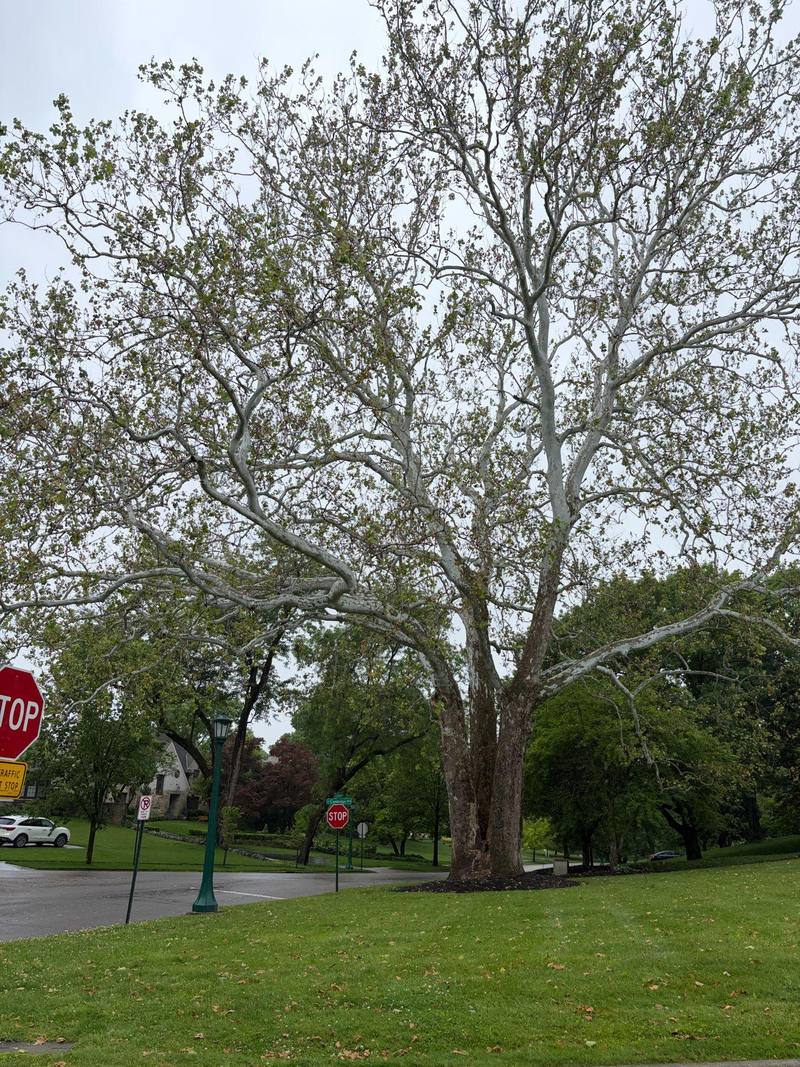
The bottomland giant of the Scioto. Too big and too blotchy (anthracnose) for a tree lawn — and there are sixteen in the city’s 2018 heritage-tree registry. The old ones aren’t going anywhere.
Flowering dogwoodCornus florida
Named in the same river company. A yard tree here — and it wants more acid than our ground usually gives, so siting and soil work matter. This one deserves a walk before a shovel.
The wider stand Sears mapped — the trees the witness records place all around this ground.
Red oakQuercus rubra
“A sprinkling of white ash and red oak,” running “in mixtures containing sugar maple and beech.” Forty-two in the heritage registry — the most of any species. Upper Arlington already voted.
White oakQuercus alba
Still in the mix on our stretch, just outnumbered by hickory. Fifteen in the registry. The tree the front-page plate is built around — the elder on the lot line.
Sugar maple & American beechAcer saccharum · Fagus grandifolia
“Beech and sugar maple” — the forest’s own name in Sears’s pages. Sugar maple is the easy half. Beech wants more acid than we have — a tree to keep where it stands, and to plant only with eyes open.
Bur oakQuercus macrocarpa
“Often scrubby, in many prairie habitats.” A lime-loving prairie oak built for exactly the soil the glacier left us. Plant it once, apologize to no one for two hundred years.
American linden & ironwoodTilia americana · Ostrya virginiana
Both named, both fine with alkaline ground. Linden for shade and bees; ironwood for the small, tough, in-between spaces.
The ring runs on — blackgum, sweet gum, cucumber magnolia, red maple, chestnut oak, white ash, elm — every one of them named in Sears’s pages. The full tier, with the soil notes, lives in the working list. More on that below.
Surveyors blazed big corner trees, so the record stops at the canopy. The layer beneath stands on E. Lucy Braun — cited now, book and page, in the footnotes — and on the riverbank itself, where pawpaw, redbud, and spicebush still grow wild. It’s also the fast half of the replant: full size in about a dozen years, while the oaks take their decades.
Eastern redbudCercis canadensis
Magenta on bare wood in April, heart-shaped leaves after, happy in the shade of bigger trees — the first thing a replant gives back. Braun puts it on limestone ground like ours; a 1971 herbarium sheet puts it on this stretch of the Scioto, at the river’s edge.
Downy serviceberryAmelanchier arborea
White flowers first thing in spring, June berries the birds strip in a week, orange fire in October. A four-season argument in a twenty-five-foot tree — wearing this list’s one honest asterisk: Braun liked it best on acid ground, and the local paper trail runs thin. The footnotes have the details.
PawpawAsimina triloba
Arrives as a patch, not a specimen, and fruits in deep shade — the largest fruit native to Ohio. The zebra swallowtail raises its young on pawpaw and nothing else — and it still grows wild along Griggs Reservoir today.
SpicebushLindera benzoin
The forest floor’s own shrub — a yellow haze in March, scarlet berries in fall, the spicebush swallowtail’s nursery. Anywhere a foundation shrub would go, this goes better. The City’s own 2022 survey of the Kiwanis Riverway found it still on the bank.
And Braun’s page runs on — witch-hazel, musclewood (her “blue beech”), wild hydrangea, alternate-leaf dogwood — the same small-tree and shrub layers, the same page 43. (American holly is on that page too, but it keeps to Ohio’s south, so it stays off ours.) Footnote 5 has the book.
For the tree lawn
The strip between sidewalk and curb is the City’s call, and its approved street-tree list has the witness forest well represented — the same City that opened an all-Ohio-native grove this Arbor Day. Where its list and this one agree, planting is easy. Start here:
Upper Arlington’s subsoil is glacial till ground out of limestone — the pH runs high, and high pH locks up the iron some trees need. Here’s the remarkable part: the witness list mostly agrees with the ground. Walnut, hackberry, bur oak, linden, the buckeyes — the forest that was here had already worked out what the soil would carry.
It also explains the town’s most common planting mistake. Pin oak is an acid-soil tree that goes slowly yellow — chlorotic, starving with food in reach — in ground like ours. It isn’t on the City’s list, and the chemistry is likely why. Yet there are eighteen mature pin oaks in the heritage registry: the mistake is old enough to be historic, and half my chlorosis calls trace back to it.
And one tree the survey never mentions earns a place anyway: chinkapin oak, a limestone specialist. If the seabed could pick a street tree, it would pick this one. The City evidently agrees — it opened its new all-Ohio-native grove at this year’s Arbor Day with five of them.
The City’s 2018 Centennial Tree Registry, counted the old way — a stroke per tree, a gate per five. Every number below already lives in the prose on this page; here they stand where you can see them.
Red oak leads — the town already voted. The eighteen pin oaks are the historic mistake one section up; the nine silver maples make their own case on the avoid list below.
Not a style. Not this year’s landscaping fashion. Five things that stay true whether or not anyone is talking about them:
Native trees feed the food web.
A native oak supports hundreds of caterpillar species; most imported ornamentals support almost none. Caterpillars are what baby songbirds eat — a single clutch of chickadees takes thousands to fledge. Plant native, and the yard gets louder in the best way.
They’re built for this exact ground.
Alkaline glacial till, freeze-thaw winters, gully-washer summers. The witness list is documented proof of fit for this soil — centuries of it — not a nursery tag’s guess.
They ask for less, forever.
A tree matched to its soil doesn’t need the pH fought or the iron forced. Most of the chlorosis I get called about is a mismatch, not a mystery — and the witness species mostly don’t make the call list.
They stay where you put them.
Callery pear is in every fencerow in central Ohio because nothing here evolved to check it. A witness-list tree has held this valley since the glacier left — without taking a single field.
They compound.
The understory reaches full size in about a dozen years; the oaks outlive the mortgage, then the century. Every native planted is the front page’s canopy plate moving one frame forward — shade, soil, birds, and property value stacking on each other.
Most of this page is a cut of a longer list. This part comes free and whole:
Already have one? Removing an invasive pays. Franklin Soil & Water’s invasive trade-in reimburses Upper Arlington residents $150 toward planting a native tree or shrub in its place, while funds last.
One reading note: a street-tree list is a list for tree lawns, not a verdict on a species. Black cherry and sycamore are wrong for the strip between sidewalk and curb — and still two of the truest things you can plant in a yard here. Right tree, right place cuts both ways.
The honest part
The witness-tree method records the canopy only — surveyors blazed big corner trees, never what grew beneath. So the shade layer rests on E. Lucy Braun — and rather than ask you to take that on faith, I pulled the books. Every understory claim above is cited below, book and page, next to the herbarium sheets and the City’s own surveys that put pawpaw, redbud, and spicebush on this stretch of the river. Serviceberry wears the one asterisk — the record is thinner there, and the footnote says so. And this page is still a cut of a working cross-reference — 120 species, Sears against Braun against the City’s street-tree list against soil pH against the heritage registry. The whole thing comes out on planting walks, matched to your actual yard.
The footnotes
Every claim on this page traces to something you can read yourself. Where the record runs thin, the footnote says so. Dive in:
The Natural Vegetation of Ohio I: A Map of the Virgin Forest — Paul B. Sears, The Ohio Journal of Science 25(3), 1925, pp. 139–149. The witness-tree reconstruction this page is built on; the hickory line and every canopy quote above sit on pages 142–145. Free PDF at OSU’s Knowledge Bank.
The Natural Vegetation of Ohio II: The Prairies and III: Plant Succession — Sears, The Ohio Journal of Science 26(3–4), 1926. The rest of the study, same shelf. Part II · Part III.
Natural Vegetation of Ohio at the Time of the Earliest Land Surveys — Robert B. Gordon’s 1966 map, with its 1969 companion volume, for the Ohio Biological Survey. The finer-grained witness-tree map — the beech-forest upland and the oak–sugar maple ribbon in the prose above are read straight from it. The map at OSU Libraries · ODNR’s GIS digitization.
The Woody Plants of Ohio — E. Lucy Braun, Ohio State University Press, 1961. Chapter and verse for the four plates above: pawpaw “throughout Ohio” (p. 149), spicebush “found throughout Ohio” (p. 150), redbud on calcareous soils like ours (p. 225) — and serviceberry “most frequent in the acid soils of the Allegheny Plateau” (p. 170), which is exactly why it wears the asterisk above. Borrowable at the Internet Archive.
Deciduous Forests of Eastern North America — Braun, 1950. The continental frame: the whole shade layer above — all eight species, the four plates and the run-on — named together in her small-tree and shrub layers, on a single page (p. 43). The copyright was never renewed, so the whole book is free to read. Full view at HathiTrust.
The herbarium sheets — a redbud collected at “Scioto River, Northwest Columbus Quad,” river edge, in 1971; Columbus redbuds from 1915; Franklin County pawpaws from 1931 and 1937. The Scioto sheet, searchable with the rest at the Consortium of Midwest Herbaria. One honesty note: OSU’s herbarium, where the deep local record sits, is mostly not yet digitized — absence online is not absence.
The living record — research-grade iNaturalist observations put pawpaw and redbud all along the Griggs corridor today, dozens strong (a pawpaw in Griggs Reservoir Park, 2025), and the City of Columbus’s 2022 survey of the Kiwanis Riverway found pawpaw and spicebush on the bank — the species list is in the preserve’s management plan.
The City’s lists — Parks & Forestry keeps the approved street-tree list and the permits for the strip between sidewalk and curb, and the 2018 Centennial Tree Registry honored trees that had, in the City’s own words, “lived long enough to bear witness to the founding of Upper Arlington.” Witness trees — their phrase and mine.
The valley keeps records in more places than I’ve looked. If you’re holding a piece of this story — a correction, an old photograph, a family tree with a history, a specimen — I want it in the working list, with your name on the contribution: [email protected].
A native from this list, matched to your soil and your site, is the front page’s canopy plate happening in real time — the forest coming back one yard at a time. That’s the work.
Text David — Plant from the List →How a planting walk works: the right tree, the right place.
The plate in motion — forest to street to canopy — is on the front page.