A homeowner called about one big Tree-of-Heaven and "a few smaller ones." We mapped a 58-stem clonal network crossing two property lines. Under a month later — after a mower woke it up — there were 202. This is that campaign, told as it happens.
Most Tree-of-Heaven calls start with a stump and a question: "Why does it keep coming back?" This one didn't. The homeowner — a photographer who raises native silk moths in her yard — had read enough to know the two things nearly everyone gets wrong.
"I know that I can't simply cut them down but need to poison the trees first. I've read about the 'hack and squirt' method but I am uncomfortable doing this myself. Would you have interest in helping?"
— Kate, first contact · May 10
She was right on both counts. You can't just cut a Tree-of-Heaven down — cut it, and it fights back harder. And hack-and-squirt is not a DIY project: the herbicide is the easy part, but the sequence and timing that keep it from backfiring are not.
I know this species. I'd been living on the family apple-cider winery in Pennsylvania, twenty minutes from Penn State — the lab that leads the nation's Spotted Lanternfly research, because that state's vineyards and orchards are the ones on the line. I read the research, and then some. The advice on Tree-of-Heaven genuinely conflicts, and the way through is to weight the sources living closest to the problem — the ones with real resources dedicated to it.
I was also straight with Kate about one thing: this was my first full Tree-of-Heaven eradication. What I brought wasn't a stack of prior jobs — it was the method, understood down to the sequence, and the discipline to run it exactly right the first time. With this species that counts for more than a tally: plenty of crews have done a dozen and still work the tree in the wrong order.
The diagnosis
One tree is a lie.
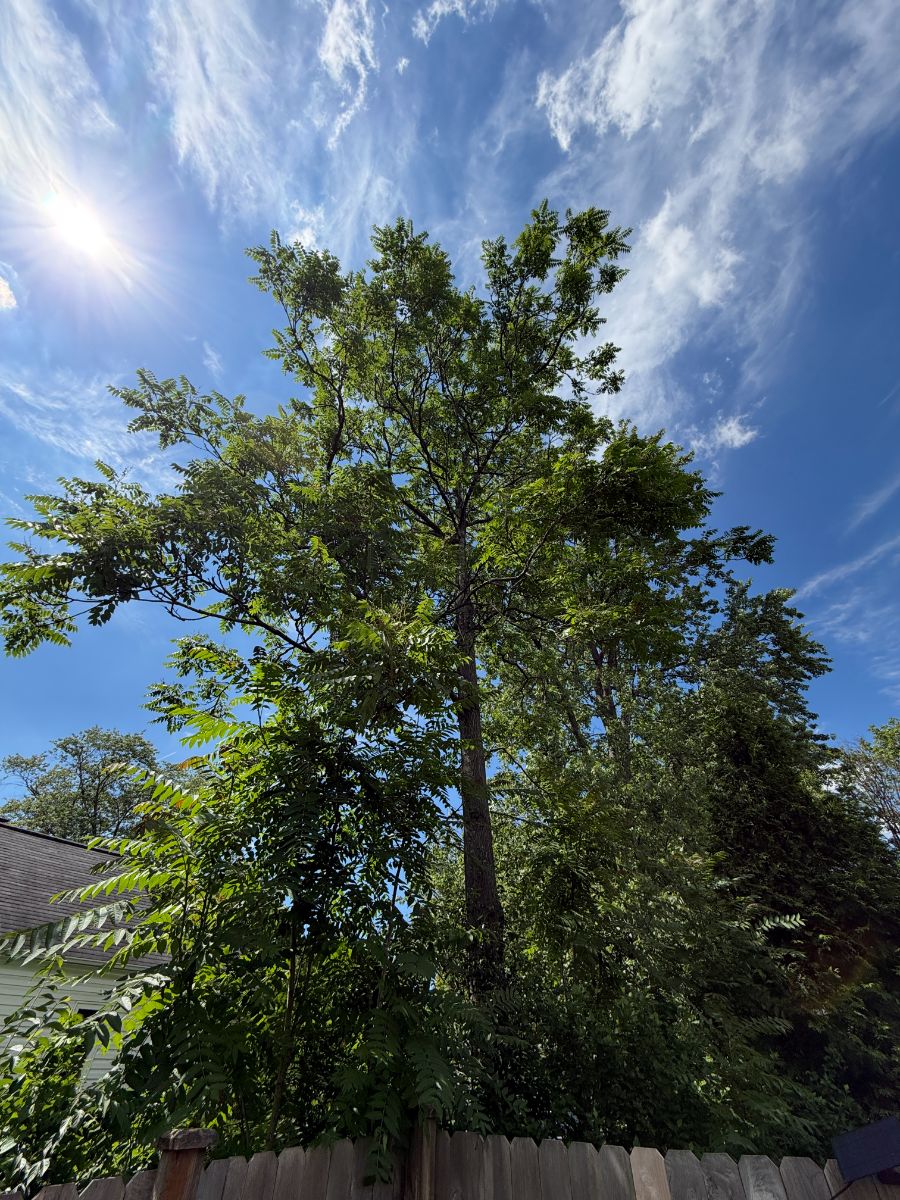
The "father" stem — about 50 feet, 14-inch trunk — with sucker growth already crowding its base and the neighbor's yard on the far side of the fence.
What looked like one big tree and a scatter of saplings was a single organism. Kate and I walked the yard and did the counts together: 58 stems — one 50-foot father, ten woody stems between one and six inches, and forty-seven suckers under an inch, all on one connected root system. She flagged every stem herself, down to the tiniest of babies — partly so nothing would get damaged by accident, partly so nothing would get missed. A photographer's eye for tiny detail turns out to be exactly the right instrument for this work.
And the root system didn't stop at the property line — it ran straight under the fence into the neighbor's yard.
Treat only the stems in one yard and the network survives on the other side. So before any herbicide touched the tree, I got both households on the same page in writing — the plan, the timing, and the one hard rule: leave every stem standing until removal. No one required that of me; it's simply how you treat a tree that crosses a property line. Then I worked both sides of the fence as one job. One tree is almost never one tree.
The plan
Kill the roots first. Cut last.
The old protocol — cut it down, treat the stump — is exactly backwards for this species. Cut a Tree-of-Heaven while it's growing and you trigger the clonal response: the roots read it as an emergency and throw up dozens of new suckers. The lead labs out east, where the lanternfly arrived first, point the other way. Treat the standing network, let it carry the herbicide down into the roots, then remove it in dormancy.
01
Treat the standing network — July
Herbicide applied to the living stems while the tree is actively moving sugars down to its roots — so it carries the dose down itself. Triclopyr, both formulations, each matched to how it's delivered.
02
Mark — don't cut
Every stem in the network carries a flag — down to the smallest — so nothing gets damaged by accident and nothing gets missed. The eleven big woody stems are marked for the removal crew. The small suckers stay standing on purpose; cutting even one now would restart the fight.
03
Remove in dormancy — November
A separate crew fells the exhausted, chemically-incapacitated network at least 30 days after treatment, once the tree is fully dormant — the point of lowest risk of triggering regrowth.
Don't cut. Don't mow. Don't pull.
Between the July treatment and the November removal, any physical disturbance triggers the clonal emergency response — and undoes the work. This is the single hardest instruction to follow, and the most important.
What happened next
58 became 202 — in under a month.
Stem count, same network
58
June 10 · mapped
→
202
July 7 · recount
Between the plan and the treatment, a routine mowing and weed-whacking along the fence line clipped the small stems — and the network answered. That kind of disturbance is exactly what releases the dormant root buds the standing tree had been holding in check, and the July recount, walked stem by stem with Kate, came back at 202. Part of that jump is new suckering the mowing triggered; part is simply a more thorough count than the first walk-through. Either way, it's a textbook demonstration of the response the whole plan is built to avoid — on the very job we'd planned it for.
What changed was material and time. The estimate had always been a range; the recount landed it at the high end, and nothing about the plan itself moved.
The work
Respect the chemistry.
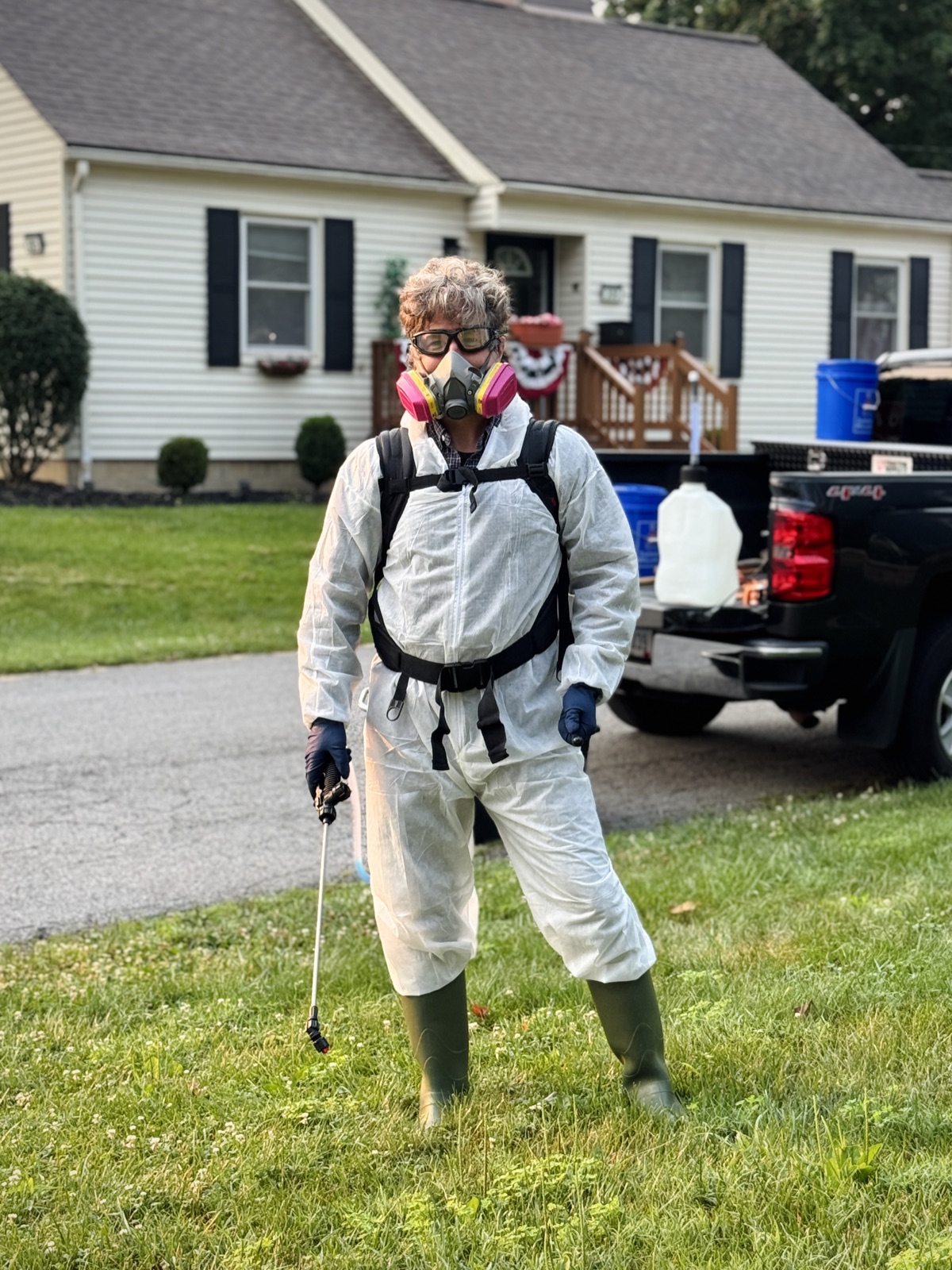
Full coverall, P100 respirator, goggles, gloves — a licensed applicator, not a spray-everything contract.Photograph by Kate
A brutal heat streak settled in the week of treatment. The chemistry works best applied under 85°F, so one full day became two — both starting at first light, 7 AM the first day and 7:30 the next, to work the cool morning hours before the heat climbed. Weather is the driver.
Here's the nuance the how-to videos skip. Search this work and all you hear is two words — hack and squirt — as if that were the whole job. It isn't. Hack-and-squirt is one method, on one stem, saved for last. The real skill is the sequence, and one rule governs it: the father stem goes last. It's the network's largest conduit — finish there, and its downward pull draws the dose through the connected stems and into the shared root system. Treat it first and you can wound that main pathway before the rest of the tree is dosed. Everything else — the smaller woody stems, the suckers, the honeysuckle — is sequenced ahead of it, in practice grouped by treatment method as much as by position.
In practice, the method set the order as much as the map. Day one: the ten woody stems — several crowded right up against the father — plus the suckers nearest her native plantings, all by basal-bark and direct wipe. Day two: the sucker mass and the bush honeysuckle laced through the fence line — and last of all, the hack-and-squirt into the father stem, the herbicide placed straight into the tree's own plumbing. The father stands dead-center in the network, and it was still the final stem treated. Every application went directly onto the target stem — no broadcast spraying, no drift.
A field lesson the research papers don't teach: the hack is the hard part. The father stem stood wedged in suckers that had to stay standing and couldn't take a nick, and Tree-of-Heaven bark is thin, papery, slick — nothing like the ridged bark a hatchet bites into. The cuts have to land evenly spaced all the way around the trunk without ever connecting, because girdling it triggers the same emergency response as felling it. Precise hatchet work with four inches of swing room is its own skill. I earned it on this tree.
And the squirt matters as much as the hack. Search this and you'll see a squeeze-trigger spray bottle — fine on an open stump, useless here. The target isn't the trunk; it's the inside of each fresh cut, a slot a few millimeters wide, on a father stem wedged in suckers that couldn't take a drop of overspray. You can't aim a spray bottle into that. So every dose went in by hand, placed cut by cut, precisely where it belonged and nowhere else — a small amount of chemistry, delivered exactly on target.
One fair question: if cutting sets off the suckering, why didn't the hacking? The difference is what the tree loses. A mow or a fell strips the canopy while the roots are alive and loaded — that's the signal that wakes the dormant root buds. Hack-and-squirt takes almost nothing off the top: the canopy stays standing, and the herbicide riding down the stem kills those root buds instead of releasing them. It's the same logic that puts removal months out, in dormancy — by then the roots are already dead, so the cut that would have set off an explosion in June does nothing in November.
Careful work
She raises native silk moths. We worked around them.
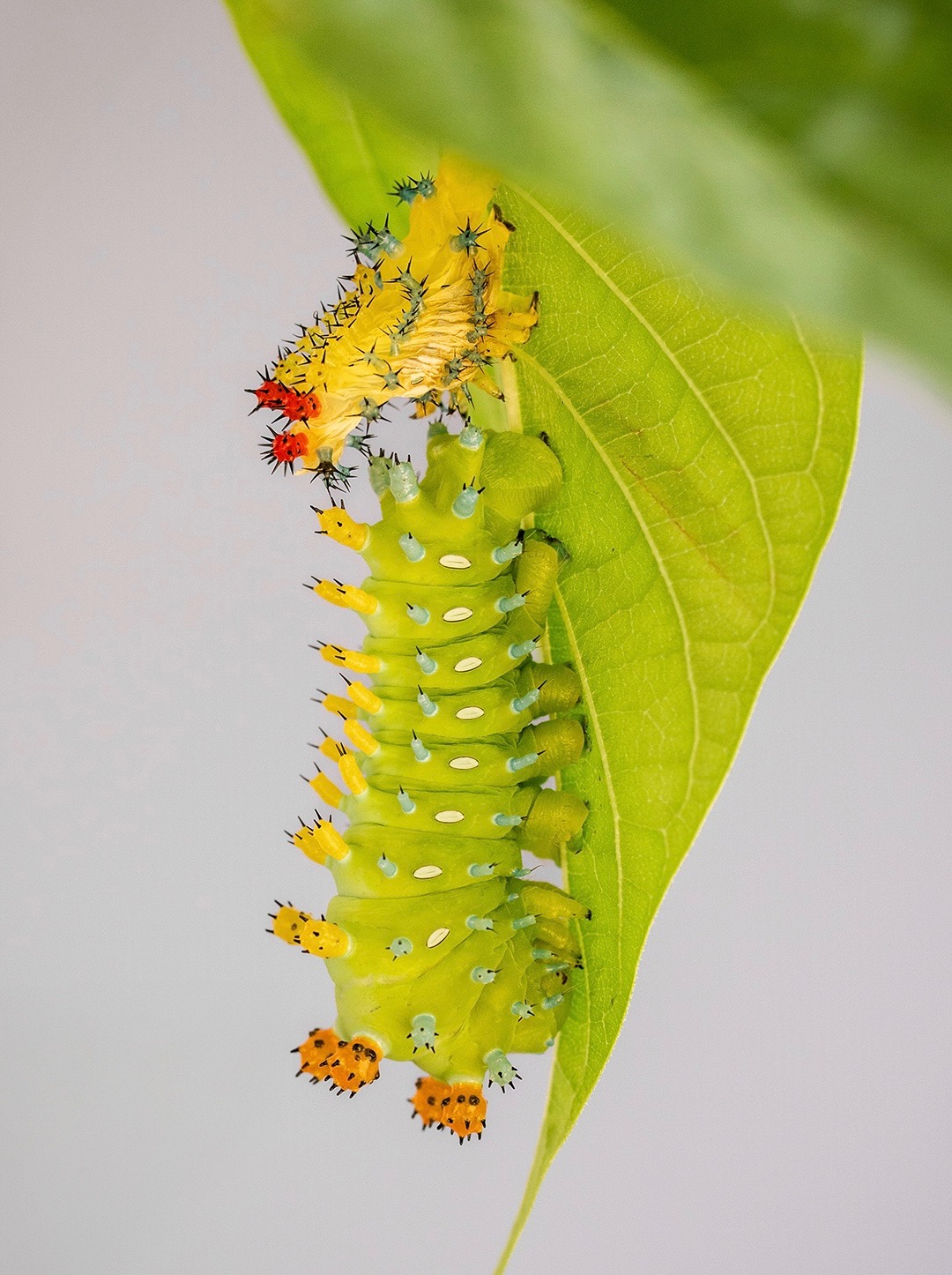
One of Kate's Cecropia caterpillars, fresh out of a molt — the shed skin still clinging to the leaf above.Photograph by Kate
Kate raises Cecropia — North America's largest native silk moth — on the river birch on the east side of her yard. Before treatment she asked the right question: any risk to the caterpillars, or should they come inside?
Inside. The herbicide isn't designed to kill insects, but the oils that carry it can harm one on contact, and a trace of drift on a birch leaf becomes something a caterpillar eats. The caterpillars spent both treatment mornings indoors, and went back out on the birch once everything was dry.
The field log
Year one is a treatment. Eradication is a campaign.
Getting a Tree-of-Heaven right takes two to three years — treat, remove, then watch for survivors and hit them again. Most operators won't stick around for that. This log is the whole campaign, and it grows every season.
May 10, 2026
First contact
Homeowner reaches out — already knows it can't just be cut down.
June 10, 2026
Network mapped — 58 stems, two yards
One father stem, 10 woody, 47 suckers, one root system across the fence — every stem flagged by Kate, down to the smallest. Both households agreed to the plan in writing before anything was treated.
July 7, 2026
Recount — 202 stems
A fence-line mowing triggered fresh suckering, and a full stem-by-stem recount put the network at 202 — part new growth, part a more complete count. The exact response the plan is built around, demonstrated mid-job. Same plan, high end of the range.
July 14–15, 2026
Treated — two mornings under 85°F
By method: basal-bark and direct wipe on the ten woody stems, foliar on the sucker mass and honeysuckle, and the father stem last by hack-and-squirt. Caterpillars indoors. Treatment complete.
November 2026 · upcoming
Dormant-season removal
A separate crew fells the exhausted network and clears the fence line once the tree is fully dormant.
Spring 2027 · upcoming
Watch for survivors
Any "babies" that rise get marked — and left standing, uncut, until July.
Summer 2027 · upcoming
Spot-treat the fighters
Treat whatever came back. Repeat until the network stays down. That's eradication.
This log is live — new entries added each season as the campaign continues.
"Very glad I didn't decide to try it on my own. Not a DIY project."
— Kate, after the job
Where the log lives
The real deliverable isn't a dead tree. It's the record.
Most Tree-of-Heaven jobs end with a stump and a receipt. This one ends with something that lasts: a chart. Every stem Kate and I flagged, every application logged to Ohio Department of Agriculture spec, and every season still ahead, kept in one place for the years an eradication actually takes.
The field log above isn't a page I hand-edit. It's a live view of this tree's record in ArbKeep, the health record for trees — a chart per tree, for its whole life, that follows the property to whoever owns it next. I'm an arborist who also writes software, and I built it for exactly this.
Your trees, on the record →Every client gets a free login from the first visit — the chart is yours to keep.
Why it matters
This is lanternfly defense.
Tree-of-Heaven is the Spotted Lanternfly's preferred breeding host. Every network brought down is one fewer nursery for the insect now under a statewide quarantine in Ohio. Done right, it protects a whole neighborhood — which the homeowner understood before I said a word: "I'm sure the entire neighborhood will benefit from this."
David All — Ohio Dept. of Agriculture Commercial Applicator #175653 (Categories 5, 6A, 6C, Core). Upper Arlington Tree Co. LLC — ODA Pesticide Business License #115340. Fully insured. Booking Tree-of-Heaven work now; multi-property coordination included.
Full disclosure: the first thing I ever published — 8th grade, UA News, 1993 — was a poem titled "Tree Heaven." Some titles come back around.
Arborist, extension specialist, or researcher with Tree-of-Heaven data to share? I read everything — send it my way. Builders welcome through Heartwood.